
Dignity in the Inferno
The comfort of nihilism and the choice to keep fighting

To the Deep Thinkers,
Welcome to the Deep Thinkers Newsletter: A collection of essays dedicated to going beyond the surface.
If you’re new here, check out the Deep Thinkers archive.
There is no greater prison than the past, and no greater threat to sanity than the specter of what could’ve been. I’m currently finding that it’s rarely the events themselves that crush us; it is the refusal to face them that does. It is in running away that we lose our dignity and let the darkness dictate which path we take.
I don’t remember the last time I didn’t feel so heavy. While there have been fleeting moments of joy throughout the years, my default state has settled into an existential exhaustion.
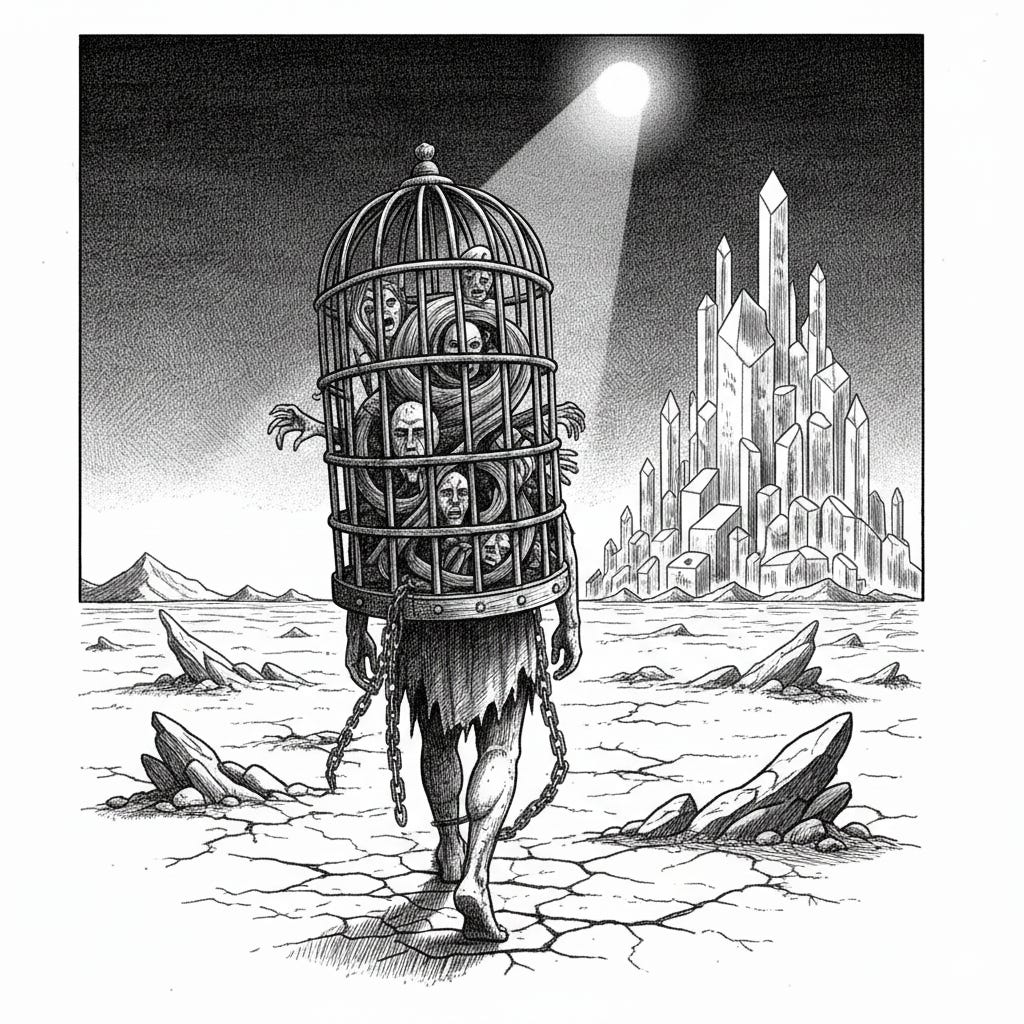
I carry an anchor chained to my soul, forged from memories of love squandered and left to wilt. I carry the consequences of a decade-long crusade to be self-sufficient—a path pushed so far past its limits that I now stand isolated, fumbling desperately with rusted vestiges of relationships I’ve long taken for granted.
Resentment, grief, shame, and rage seem to be all I feel. Without an outlet, they threaten to smother me to death, making me feel older than my years, closer to my end than to my salvation.
As I enter a new year, I’ve finally looked down to see the ruins. My career, my relationship, my finances, my creative output, and my emotional well-being were all on autopilot. I’ve neglected them all, and now I’m living with the consequences.
I haven’t just been stagnant, I’ve been self-sabotaging. I am on a hamster wheel, repeating the same patterns with only slight variations in the scenery. In confronting this reality, nihilism has become my shell of comfort.
It’s a slow death—giving into apathy—but it’s also an easy one. It is always easier to isolate, to ignore messages, and to abandon the hard work for the instant gratification of escapism. I am repeating the patterns of my childhood, back when I had very little agency. But what kept me sane as a child is simply a cage I’ve placed myself in as an adult.
The thought that life is meaningless isn’t just a philosophy for me; it’s a survival tactic. If nothing matters, the pain shouldn’t either. But the wave always hits harder on the way down, and deluding myself for as long as I have is no way to continue living.
The Worthy Sculptor
In the anime Cowboy Bebop, the characters are paralyzed by the weight of their past, stuck in time, and leaning into a profound sense of nihilism toward existence itself.
The main character, Spike Spiegel, describes this state as a literal rift in his vision: “I’ve been seeing the past in one eye and the present in the other. So, I thought I could only see patches of reality, never the whole picture.”
He is describing the grief of paths left unexplored, not just the sorrow of what happened to us, but the process of mourning what didn’t. Often, this weight forces us to look back not to understand, but only to lament the person we never became.
In Cowboy Bebop, catharsis is only achieved when the characters confront the past directly. The process is not about finding a happily ever after. It’s about reclaiming a modicum of dignity before it’s all said and done.
Viktor Frankl frequently cited Dostoevsky’s greatest dread: “not to be worthy of my suffering.” This idea has become a persistent one in my own life, forcing me to wonder if I’ve squandered the very hardships that were meant to forge me into something greater.
We all suffer. I know people who have endured far greater traumas than mine, yet they move through the world with a lightness I envy. They are not running, because they know that running in itself is an act of unworthiness—a loss of human dignity. When we avoid pain, the only lesson we truly learn is that we are afraid of it, and that is not a lesson worth learning.
We are constantly being forged by our experiences, but we often mistake mere endurance for progress. Think of your past as a pile of wet clay. If you leave your life unresolved through escapism, you surrender your freedom to take part in the sculpting. You let the material pile up—shapeless, heavy, and useless. You watch it accumulate until it dries and eventually hardens. Once that clay sets, change feels impossible. It ceases to be raw material and becomes a monument to your own stagnation.
To be “worthy of your suffering” is to get your hands dirty before the clay turns to stone.
Becoming the Worthy Sculptor is a choice. Resilience is not an accident. It’s the choice to find meaning in the midst of the mess. We can accept that the universe is indifferent and still choose to do our best. We can choose tragic optimism over the easy path of defeat.
The Source of Bliss
A life without suffering is an idyllic fantasy—a map of a country that doesn’t exist. Because there is no outrunning the darkness, we need a framework that does more than just help us survive it. We need tragic optimism. It is not the delusional belief that things will get better. It is the defiant conviction that we can uncover meaning in the darkest of times.
There is a common perception that optimism is a superpower—a shield that deflects the arrows of despair. But true optimism is less a shield and more a reservoir.
Those who remain dignified in the face of suffering aren’t “naturally” happy. They are simply the ones who refuse to let the darkness command their fate. They understand that joy, however fleeting, is a data point, proving the void is not absolute.
If the darkness were all-encompassing, the light shouldn’t exist at all—and yet, there it is. Their strength comes from the refusal to let a season of shadows forecast a lifetime.
In the book The Gate of the Feral Gods, the protagonist, Carl, reflects on how he created his own pocket of bliss in the middle of his childhood trauma. He recalls being young, abandoned, and confined to a basement, and how a simple game console became his source of strength within what was a very dark existence.
He reminds us that the environment or circumstances don’t have to be perfect for the peace to be real.
It brought me back to a distant memory of happiness, even if it was just for a moment. I’d only gotten good at the game because I’d always been locked away in the basement while my dad had friends over. Still, you could do that. You could take a terrible situation and still find moments of peace, even joy. I needed to be reminded that was possible, and the game console did exactly that.
This is the engine of tragic optimism. It is the reminder that peace is possible even when you feel imprisoned. Carl didn’t need the basement to disappear to find bliss. He became the commander of his internal world while the external one remained a cage. This is the spark that keeps the sculptor’s hands moving when the clay feels cold, and the room is pitch black.
To do this work—the kind of work meant to conquer nihilism—I must stop burying the pain and start respecting the scars it left behind. Scars are not merely evidence of trauma. They are also the grain and the texture of an ongoing masterpiece. Without the scars, there is no story.
The Effort of Becoming
I wish I could say that knowing any of this makes the climb out of despair any easier, but the truth is, I’m tired. My spirit remains heavy, and on many days, it’s easier to let the clay dry into a shapeless mass than it is to keep refining the edges. I am not fighting a fantastical war of good versus evil. I am fighting a quieter kind of battle: the effort of becoming versus the ease of comfort.
Nihilism is the easiest path. It whispers that it is already too late, so why bother? Why give so much when nothing goes according to plan? If the clay is already drying, why bother shaping it? To stay malleable is to stay vulnerable, to bruise easily. However, hardening into apathy offers a fortress of false protection, a shell that keeps us “safe” only by ensuring we never truly live again.
The ghost of the person I didn’t become acts like a shackle on my wrists, dragging at my hands as I try to work the clay. There is a profound tension here. I understand the logic of tragic optimism, but the sorrow is bone-deep—a physical resistance to the work ahead. In trying to outrun history, I’ve only added to its weight. So the goal can no longer be to escape, but to decide what to do with the material it has left behind.
The Armor and the Laugh
Without tragic optimism, resilience feels like a hollow prize. I have been “strong” for most of my life, but it’s always been strength born of gritted teeth and bitter reluctance. I was always fighting against my past rather than moving through it. This resistance has always kept me from the present, fostering a shrouded view of my own story and driving me toward the numbing comfort of apathy.
Tragic optimism offers a peace designed to keep us upright in the middle of the storm and defiant in the face of the void. When I reframe what I’ve endured, the weight shifts. It ceases to be a burden and becomes armor instead. Every scar and every wound is etched into that metal—symbols of the battles I’ve survived.
Despite this season of darkness, I see the man I want to be on the other side. I see him clearly. He is present, anchored in the now, and he knows nihilism is a luxury he can no longer afford. He remains upright through every season, a symbol of strength not just for himself, but for those who depend on him.
He looks back at the moments that feel like they are breaking me now—and he laughs. Not because the pain is funny or because it doesn’t hurt, but because he sees the suffering for what it truly is: the catalyst. He knows he was forged in a fire meant to ignite a life of passion, not a life of mere existence.
Happiness is a secondary goal. My priority is to stay in the fight. In the end, we don’t just survive the fire. We learn to thrive in the heart of the inferno.

Enjoying the essays? Consider becoming a paid subscriber to support more thoughtful, in-depth work like this.
Or leave a one-time tip—every little bit helps
Your support, whether monetary or simply sharing this essay, means the world to me.
✍🏾 In Case You Missed It:


Much love,
—Jon ♾️