
The Only Certainty is Chaos
Trying to think my way to peace

To the Deep Thinkers,
Welcome to the Deep Thinkers Newsletter: A collection of essays dedicated to going beyond the surface.
If you’re new here, check out the Deep Thinkers archive.
I am an overthinker, someone rarely at peace, but someone who tries all the same. I don’t remember exactly when my own thoughts turned against me, but I’ve been locked in this quiet war with myself for far too long now. Maybe it was the slow disillusionment of my teenage years, or the trial by fire that were my twenties, navigating the world with no guidance and trying desperately to keep my head above water.
While I don’t necessarily like this about myself, I’ve come to realize that my mind is not a broken machine to be repaired, but a landscape to explore and understand. I can’t stop overthinking, but maybe I can channel it. Maybe I can use the very intensity that threatens my peace to build a fortress against all this chaos around me.
The Illusion of Control
Too often, we treat life like a math problem that can be solved if we just find the right variables and combinations. We plan, we optimize, and we curate, operating under the quiet delusion that we can bend the universe to our will if we just crunch the numbers in just the right way.
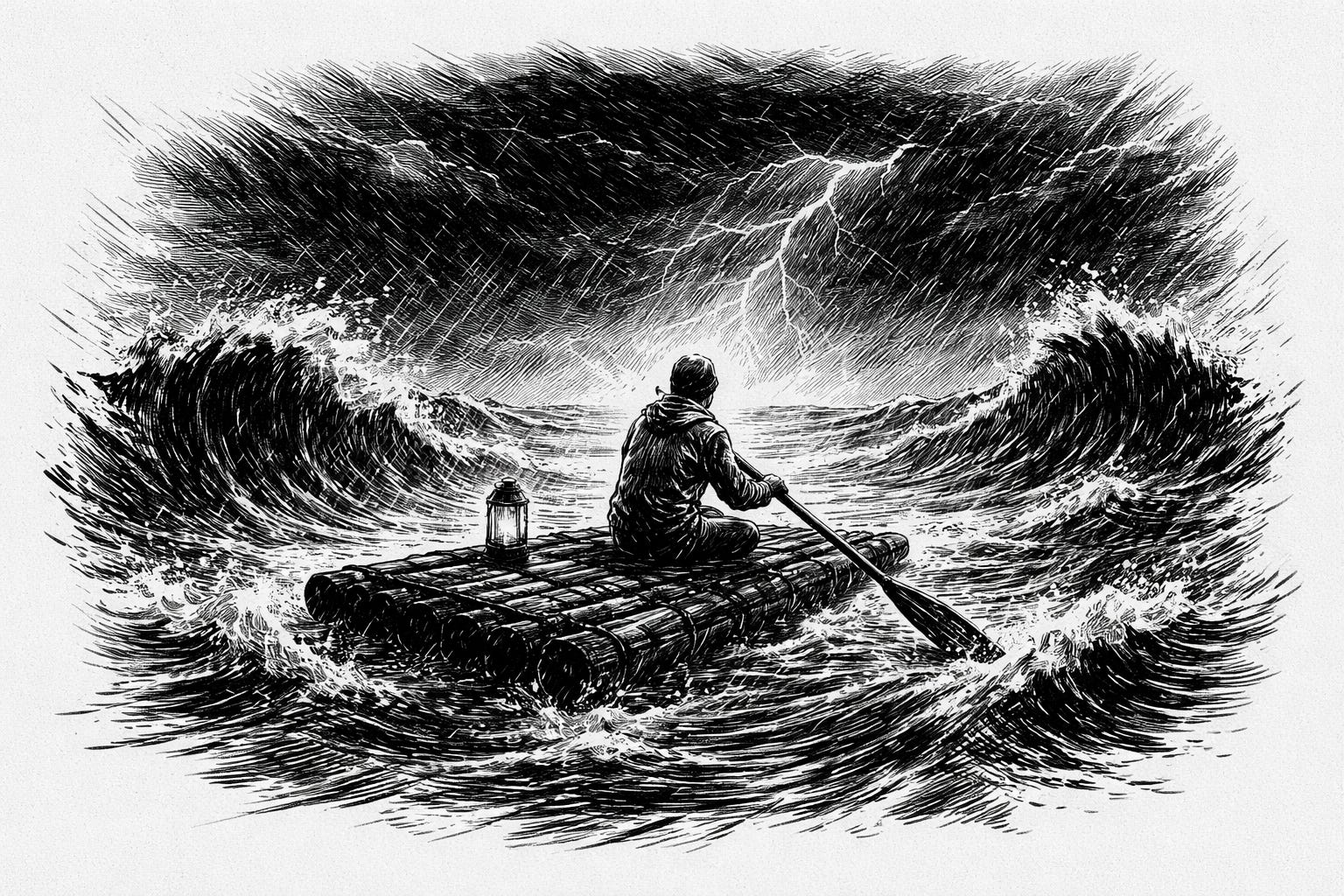
But life’s not an equation waiting to be solved. It’s a storm that ebbs and flows, and we’re all just doing what we can to keep from being capsized. Funny enough, the very chaos we try to avoid seems to be the only natural order the universe has ever known.
Heath Ledger’s Joker—a man who was equal parts philosopher and raving lunatic—famously noted: “You know the thing about chaos? It’s fair.”
He was right. Chaos doesn’t have an agenda. It doesn’t care about your social standing, your money, or even your intentions. It is a force outside our whims and desires. Chaos simply is. We don’t live in Gotham City—though the 'national security' agents terrorizing our communities make the comparison feel closer by the day. Regardless, our world is governed by the same unyielding unpredictability. The whiplash we feel, moving from moments of peace to sudden disarray, isn’t a glitch in the system. It is the system.
I’ve spent multiple years now trying to unlearn a dangerous habit. I realized that my darkest moods were rarely triggered by the world around me, but by the friction between reality and my own expectations. I’d fallen into the trap of thinking things would eventually fall into place—an insidious passivity that turned into bitterness. By labeling every obstacle that sprouted along the path as “bad,” the more I surrendered my power to a story that only served to keep me buried in negativity.
Marcus Aurelius wrote: “Choose not to be harmed—and you won’t feel harmed.”
On its own, a quote like this can feel reductive, a callous wave of the hand in the face of true suffering and injustice. But while it isn’t the magic elixir for the world’s systemic cruelties, it can be a powerful tool when we personalize it. When we provide our own context, it becomes a source of strength. Peace is not found in trying to bend the world into a form devoid of chaos. It’s found in those pockets of space created when we refuse to surrender to apathy. Playing the victim is nothing more than a silent concession of our own potency, leaving the soul to scream and thrash in anguish while the world continues to spin, indifferent, as it’s always been and always will be.
The Internal Sanctuary
Chaos is hardest to navigate when you’re sedated by apathy, clinging to escapism and the hollow allure of numbness. True strength—the kind that inspires—isn’t the absence of fear or the hope for a better season. It’s about recognizing that even in the harshest of storms, there is always an opportunity to build. It’s the shift from being a victim of your circumstances to becoming the architect of your soul.
You will lose your cool. You will sometimes respond in anger. That is part of being human. Ultimately, as you build yourself into the person who can weather any storm, you’ll need grace as you uncover the why behind your fear, your pessimism, your overthinking.
For me, this begins with an audit—a cold look at where my time and attention are being spent. Without this, I can’t discern the natural chaos of the world from the infernos I am personally fueling. I have to remember that one day I won’t be here, that everything eventually perishes, and the ‘disasters’ of today are often just temporary shadows or invitations to grow stronger.
Escapism—whether physical or spiritual—cannot save me. Wherever I go, there I am, carrying the mind of an overthinker. True stillness (the kind that saves) requires me to stand and face the darkness, to see for myself if it is truly as formidable as my mind makes it out to be. Finally, I must challenge my first impressions. That initial surge of emotion rarely holds the truth. It’s a reflex, a survival mechanism, a specter of old trauma. This doesn’t mean these responses are meaningless, but they must be questioned. I have to understand them before they become my undoing.
No matter how different we are, we are all facing a singular force of nature: fate. The chaos that fate brings is unending. It is the texture of existence. Our role is not to vanquish this force or to conquer the storm, but to learn how to navigate atop the waves without letting them pull us under. It starts with the quiet, radical responsibility of owning our internal state, even—and especially—when the external world is falling apart.

Enjoying the essays? Consider becoming a paid subscriber to support more thoughtful, in-depth work like this.
Or leave a one-time tip—every little bit helps
Your support, whether monetary or simply sharing this essay, means the world to me.
✍🏾 In Case You Missed It:

Much love,
—Jon ♾️
Jon. An excellent article with a very modern Stoic twist. I had to restack because your piece will help others deal with natural chaos, but more importantly the self-generated chaos.
So much of this reflection resonates with me: treating current events as a math problem, the Marcus Aurelius quote, apathy as something we must refuse to surrender to... Then I looked at the biggest turning points in my life and I saw that I did not adapt to "the way it was." I acted to change even if it might not have been easy. Your deep thinking and the writing it are excellent.